The Governance Gap in Enterprise AI
Every regulated industry operates on the assumption that critical work is traceable. Financial services tracks who approved a trade. Healthcare logs who accessed a patient record. Legal teams maintain revision histories on every filing. These systems exist because high-stakes work — due diligence, auditing, financial accounting, regulatory compliance — demands knowing who changed what, when, and why.
AI agents are now performing the same caliber of work. They aren't just drafting text or summarizing documents — they're conducting multi-source analysis across complex data types, updating financial models in spreadsheets, generating audit-ready reports, and executing workflows that span entire teams and systems. The scope is no longer simple document handling. It's deeply technical, complex knowledge work — the kind where a single untracked change can cascade into material risk.
The question facing every enterprise is straightforward: do you have the controls in place to properly govern this?
The gap today is significant. An analyst might make a few dozen edits to a financial model in a day. An agent operating across the same assets can make hundreds of changes in minutes — across spreadsheets, documents, and workflows simultaneously. Without purpose-built governance infrastructure, the volume of untracked, unattributed changes compounds quickly.
And it's not just the volume that creates risk — it's the rate at which agents themselves evolve. Models get upgraded. Prompts are refined. Source materials are updated. The agent that produced Monday's output is operating with a different configuration than the one that runs on Friday. When an output shifts unexpectedly, understanding why requires visibility into not just the asset, but the agent's complete state at that moment in time.
This is the gap AGS was built to close — not as an afterthought bolted onto existing tools, but as foundational infrastructure for organizations doing their most critical work with AI.
Why Existing Approaches Fall Short
Most collaboration tools offer some version of history — periodic snapshots, basic revision tracking, manual version saves. These were designed for human-speed workflows where changes happen in discrete, infrequent sessions, typically within a single file type.
They break down in agent-heavy environments for three reasons:
Attribution is incomplete. Traditional history panels show that something changed, but don't clearly distinguish between changes made by different agents, different users, or combinations of both operating across the same assets simultaneously. When agents are working across spreadsheets, documents, and complex multi-step workflows in parallel, the attribution problem becomes exponentially harder.
Rollback is all-or-nothing. If an agent introduced a problematic edit to a financial model three days ago, the only option in most systems is to revert the entire asset to a state before that edit — losing every subsequent change from every other contributor. In environments where multiple agents and analysts are collaborating on deeply technical work — due diligence reviews, compliance documentation, earnings analysis — that's not a viable option.
There's no provenance chain. Even when you can identify that an agent made a change, you can't see why. What model was it running? What were its instructions? What data sources was it referencing? Without that context, you're left guessing — which is unacceptable in regulated environments where every decision needs to be explainable and every output defensible.
These aren't feature gaps. They're architectural gaps — and they require purpose-built infrastructure to close.
AGS addresses all three.
The Athena Governance System
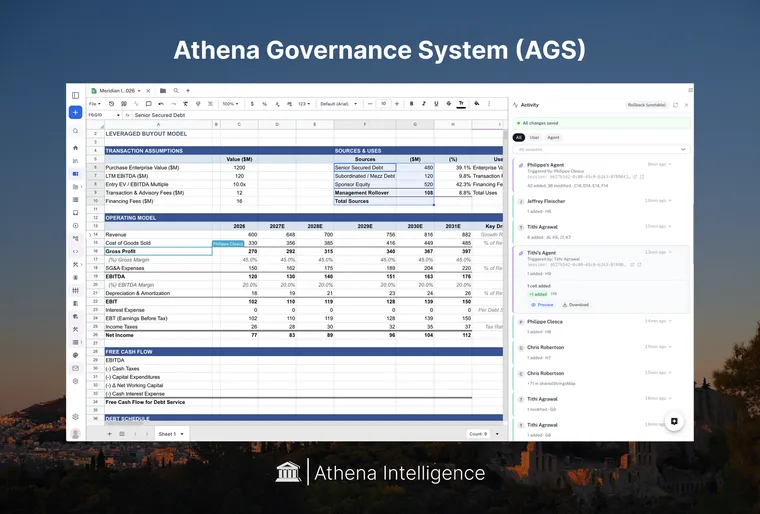
AGS is the governance layer built into Athena's platform. It runs automatically across every asset type — documents, spreadsheets, workflows, agent configurations — with no setup required and no impact on performance. Whether your team is conducting due diligence across hundreds of source files, managing financial models, or running multi-agent analysis workflows, AGS provides the controls and visibility that make deployment trustworthy.
It provides four core capabilities:
1. Complete Activity Tracking
Every change. Every user. Every agent. Automatically.
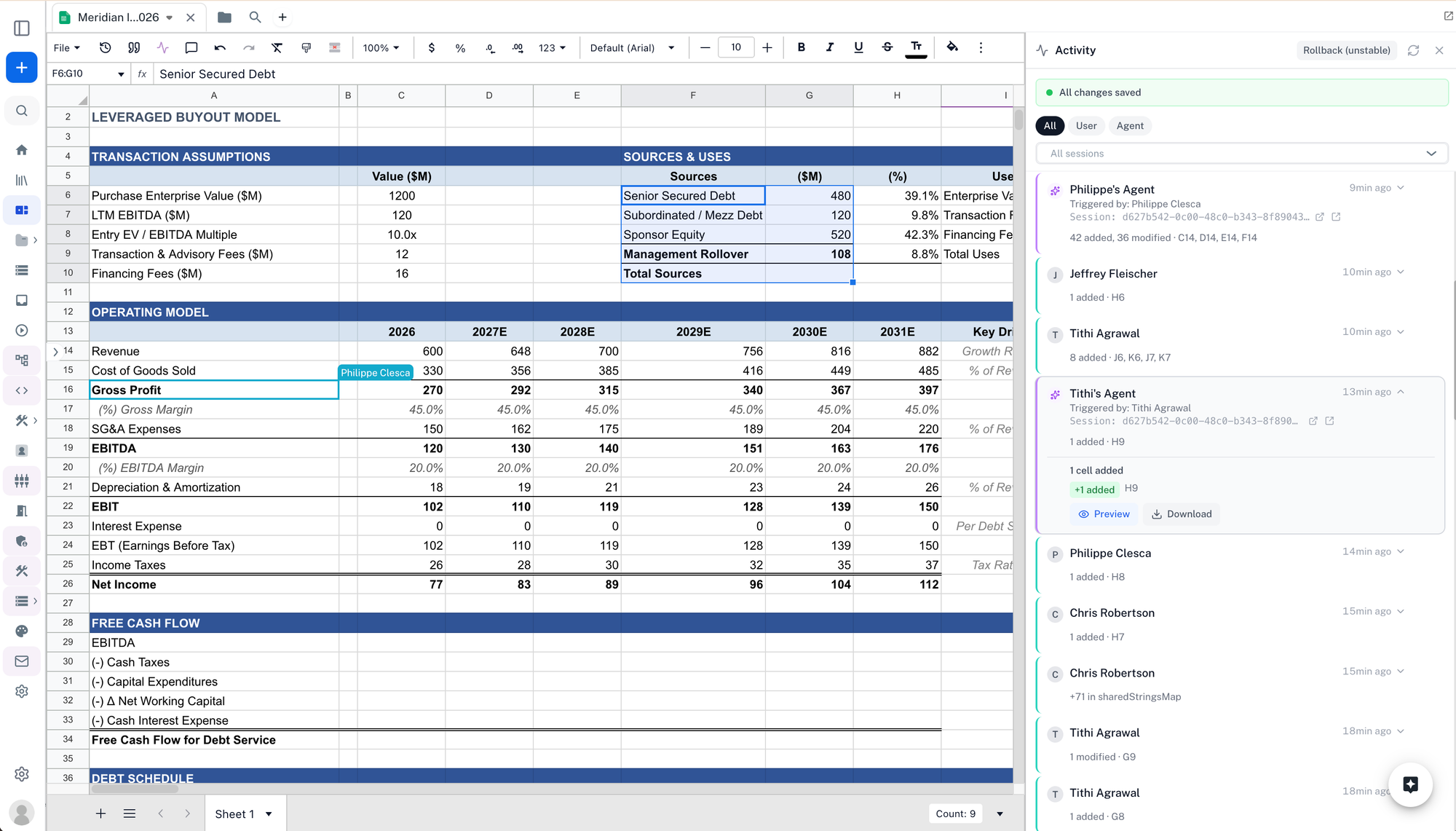
Every change to every asset is captured in a continuous, immutable activity log. Each entry records who made the change (user or agent), exactly when it occurred, and precisely what was added, modified, or removed — whether that's a cell in a spreadsheet, a paragraph in a document, or a configuration change in a workflow.
This isn't periodic snapshots or session-level summaries. It's a granular, operation-level record that runs in the background from the moment an asset is created. When multiple agents and users are working on the same financial model, audit document, or research output simultaneously, every individual contribution is tracked and attributed separately.
The activity log is filterable by contributor — isolate just the agent's changes, just a specific analyst's edits, or view the full interleaved history across all participants. For compliance and audit purposes, this creates a complete data provenance record across every asset type in the system, without requiring any manual action from users.
There is no latency impact. No additional storage to manage. The system records everything, across every data type, all the time.
2. Selective Rollback
Undo all the agent edits from a week ago — without losing anything else.
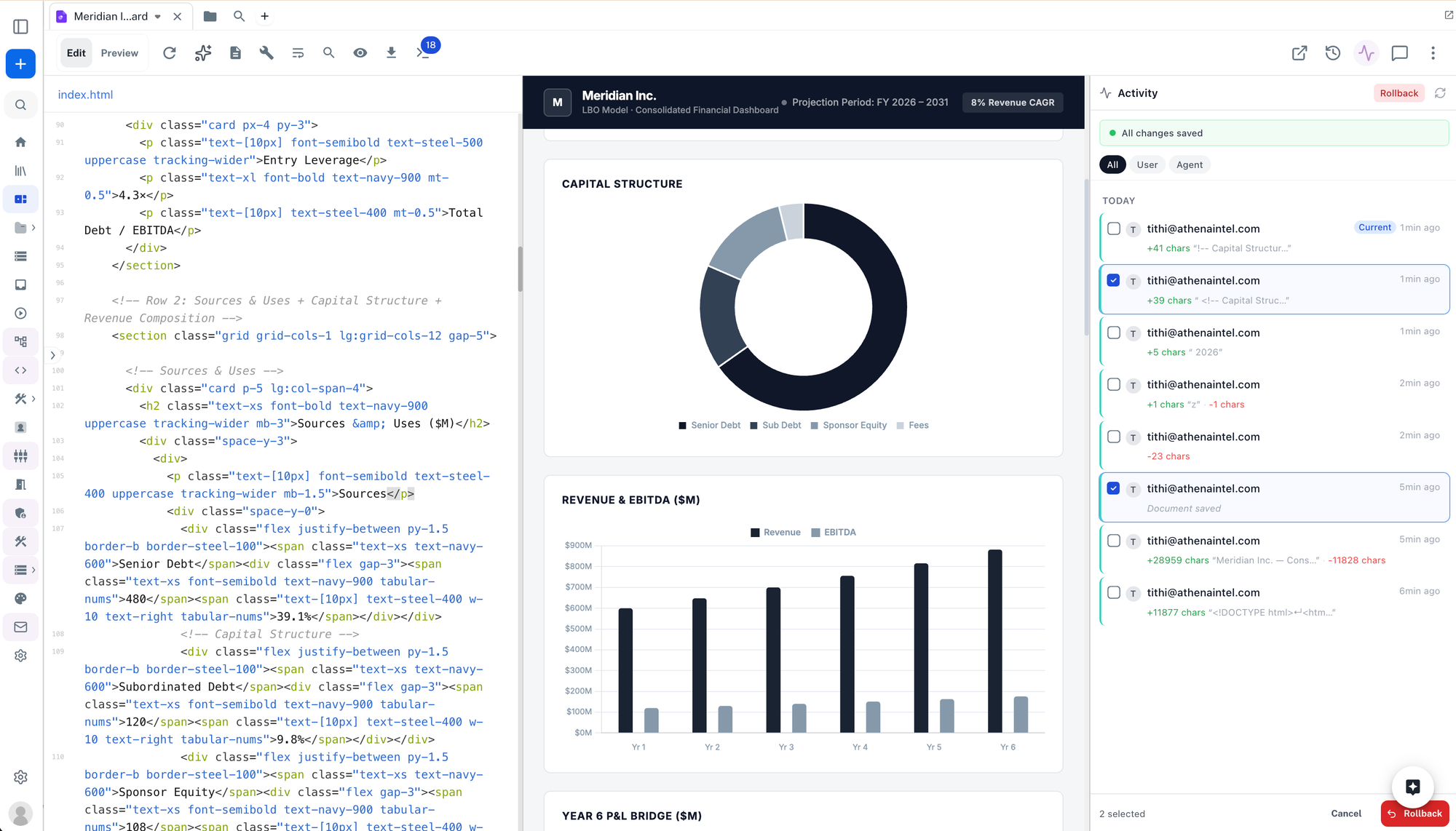
Standard undo operates sequentially — you reverse the most recent change, then the one before it, and so on. Standard version revert operates as a full reset — you go back to an earlier state and lose everything in between.
Neither approach works when multiple contributors — human and AI — are collaborating on complex deliverables over extended periods.
AGS provides selective rollback: the ability to reverse specific changes from a specific contributor — regardless of how many other edits have occurred since. An agent introduced an inconsistency in a due diligence checklist last Tuesday? Roll back that agent's changes from that session. Every other edit — from other agents, from human analysts, from any time before or after — remains intact.
This works across any time horizon, any asset type, and any number of intervening changes. You're not constrained to undoing recent actions. You can reach back days or weeks and surgically reverse a specific set of edits without disrupting the current state of the work.
When multiple users need to perform rollbacks simultaneously — or when rollbacks overlap with ongoing edits — the system handles conflict resolution automatically. There's no risk of two people's rollbacks interfering with each other or corrupting the underlying data.
3. Track Changes & Visual Comparison
See what changed and take action on it.
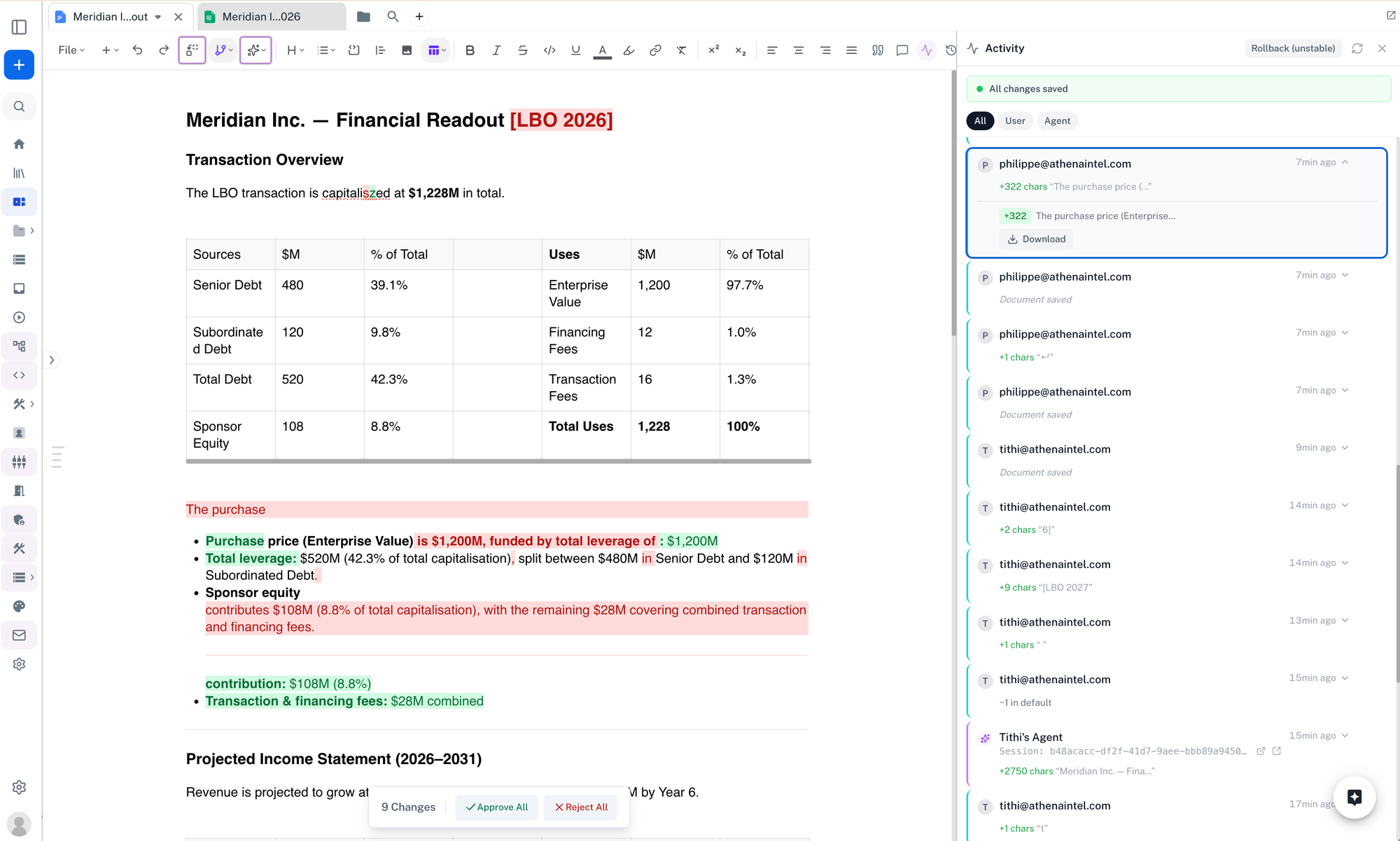
The activity log captures everything. Track changes makes it visible and actionable.
When enabled, track changes highlights every edit in real time — additions in green, deletions in red — with the ability to accept or reject each change individually. This applies equally to human edits and agent edits. A reviewer can scan through an agent's overnight work on a compliance report or financial analysis, approve the substantive changes, and reject the ones that don't meet standards — all without leaving the asset.
Beyond real-time tracking, AGS supports comparison between any two points in an asset's history. Select two named versions, two activity snapshots, or the current state against any historical state, and view a clean visual diff of everything that changed — across documents, spreadsheets, and workflows alike.
This also enables differential analysis — the ability to ask targeted questions about what changed between two states. Rather than reading through a raw diff, a reviewer can query: what substantive changes were made to this financial model between the Q3 draft and the board-approved version? The comparison becomes an analytical tool, surfacing meaningful changes in complex deliverables rather than requiring manual review of every edit.
4. Versioning & Agent Provenance
Don't just know what the agent changed. Know why it made that decision.
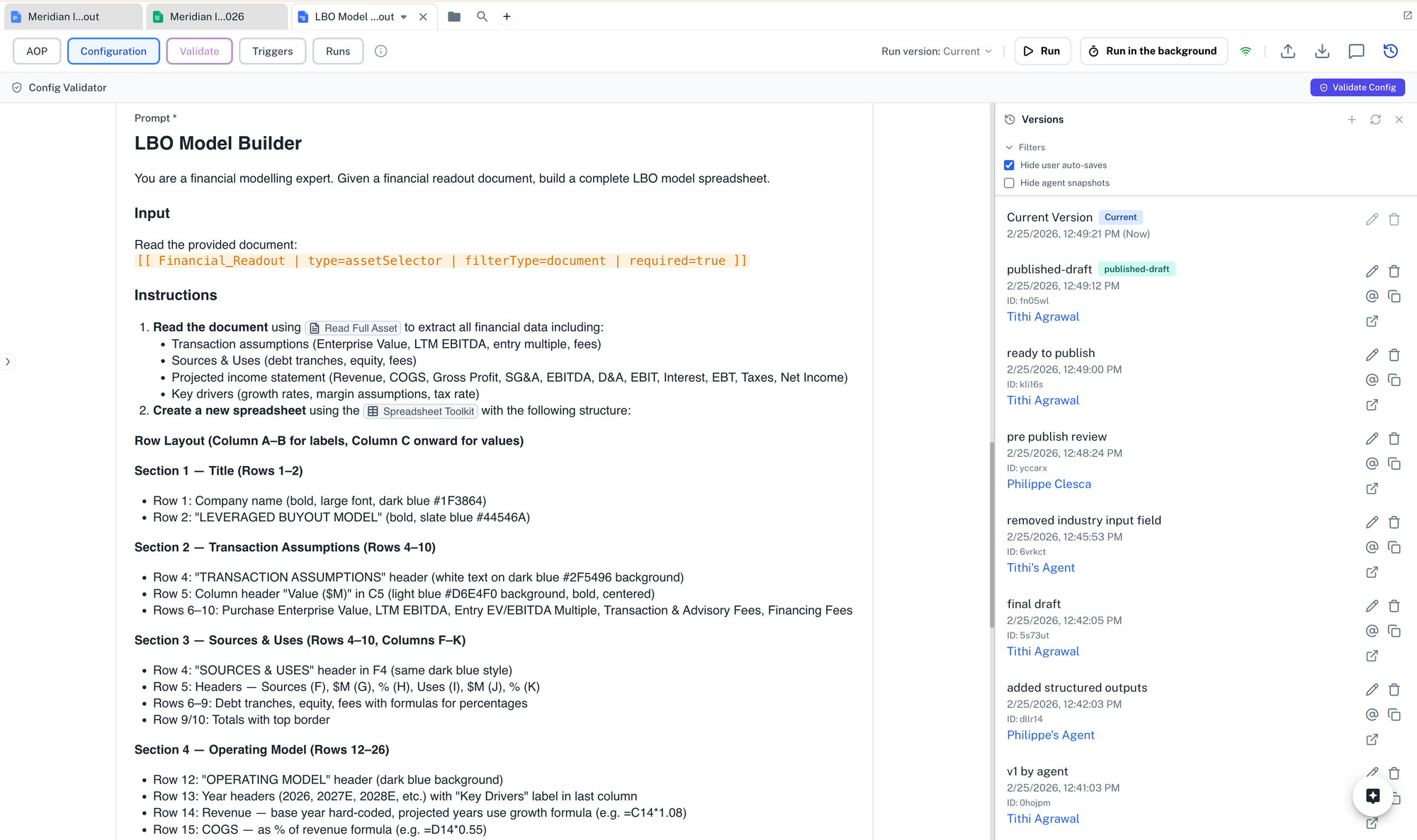
AGS maintains two complementary systems: a continuous activity log that captures every individual change, and a versioning layer that provides named reference points within that timeline.
Versions are human-created labels — "Q3 Draft," "Board Approved," "Production" — that mark specific points in an asset's history. They're optional, lightweight, and useful for the same reasons version tags are useful in any collaborative environment: they give teams a shared vocabulary for referencing specific states of a deliverable.
But the deeper capability is agent provenance.
When an agent makes an edit, AGS captures more than the change itself. It records the complete agent configuration at that exact moment: which model was active, what instructions the agent was operating under, which tools were enabled, and the state of every source document the agent was referencing.
This creates a traceable chain from any edit, through the agent that made it, to the underlying materials that informed the decision:
Asset change → Agent configuration at that moment → Source materials at that moment
If an agent's output on a financial analysis or compliance review changes between two runs, you can trace back through this chain to identify exactly what shifted: a model was updated, a prompt was revised, a source document was modified. The provenance is complete and deterministic — there is no ambiguity about why a change occurred.
Version aliasing extends this further. Teams can designate specific versions as "staging" or "production," allowing developers to iterate on agent configurations and test new approaches while the rest of the organization continues working against a stable, verified version. When changes are validated, the alias is updated and the new version becomes the production standard — with no disruption to ongoing work.
AGS exists because governance isn't something you add after deploying AI agents — it's the foundation that makes deployment trustworthy in the first place. The question isn't who's governing your AI. It's whether you have the controls in place to govern it at all. Complete activity tracking across every data type, selective rollback at any time horizon, visual comparison for actionable review, and full agent provenance together provide organizations the infrastructure to deploy AI agents on their most complex, most critical knowledge work — due diligence, financial analysis, regulatory compliance, and beyond — with the same rigor and accountability they've always demanded of their human teams.