Software as a Service gave you a tool. Service as Software gives you a worker.
For two decades, SaaS redefined how enterprises access technology. It removed the need to install, maintain, and host software internally. It lowered upfront costs, accelerated deployment timelines, and made enterprise-grade capability available to teams regardless of size or infrastructure. That shift mattered because the bottleneck at the time was access. Most organizations simply could not get their hands on the software they needed fast enough.
That bottleneck has moved.
Today, most enterprises have access to exceptional tools. The challenge is not capability — it is throughput. There is always more to build, more to ship, more to improve. The opportunity in front of most organizations is expanding faster than any team can keep pace with. The question is how to capture more of it.
This is where a new model is beginning to take shape — one where software does not just provide capability, but provides capacity. Where the output is not a better interface for humans to work inside of, but finished work delivered on behalf of humans. The distinction is subtle in language but significant in practice. It is the difference between Software as a Service and Service as Software.
The Evolution, Not the Replacement
It is important to be precise about what is changing and what is not.
SaaS solved a real problem. Before it, enterprises spent months on procurement, installation, and configuration before a single user could log in. SaaS compressed that timeline from months to minutes. It also shifted the economics — from large capital expenditures to predictable operating costs. These were meaningful structural improvements, and they are not going away.
But the operating model underneath stayed largely the same. The software provides the capability. The human provides the labor. A team subscribes to a design tool, and the designers still design. A team subscribes to a project management platform, and the project managers still manage. The software made the work more efficient, but it did not change who was responsible for doing it.
The question enterprises are increasingly asking is not "do we have the right software?" Most do. The question is "how do we move faster with the team we have?" Every organization has a backlog that grows faster than the team can work through it — not because the team is lacking, but because the opportunity in front of them keeps expanding.
This is the gap that Service as Software begins to close.
Owning a Service, Not Just a Software
The distinction between these two models comes down to what you are actually purchasing.
When you subscribe to a software tool, you are purchasing capability. You get an environment, a set of features, and access for your team. What you do inside that environment — and how much gets done — depends entirely on the people you staff against it. The software scales with seats. The work scales with headcount.
When you own a service, you are purchasing outcomes. You describe the work that needs to happen. The software plans the approach, executes against it, follows your internal standards, and delivers a result. The work scales with demand, not with the number of people available to do it.
Consider the difference in concrete terms.
A tool gives you an editor. A service gives you an engineer. You describe the requirements. The service determines how to approach them, writes the implementation, validates it against your testing standards, and delivers working output — all within the conventions your team has already established.
A tool gives you a blank canvas. A service gives you a finished deliverable. Not a template that still requires hours of manual refinement. A complete output, built to the specifications you provided, ready for review.
A tool scales with seats. A service scales with the work itself. You do not add more licenses to get more throughput. The software absorbs the workload directly.
This is not a difference in sophistication of interface or quality of user experience. It is a fundamental shift in who is responsible for the labor. And for enterprises operating under persistent capacity constraints, that shift changes the calculus entirely.
What This Looks Like in Practice
To make this concrete, consider what it means to have an AI developer on your team — not an AI-assisted development tool, but a developer that operates autonomously within the boundaries you define.
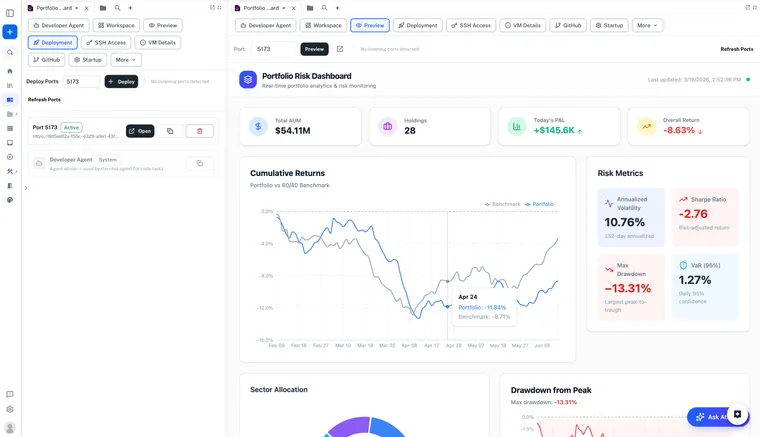
This is what we built at Athena. The computer asset is an isolated, on-demand development environment where an AI developer can plan, build, test, and deploy software on your behalf. It is the embodiment of the shift described above — from software you operate to software that operates for you.
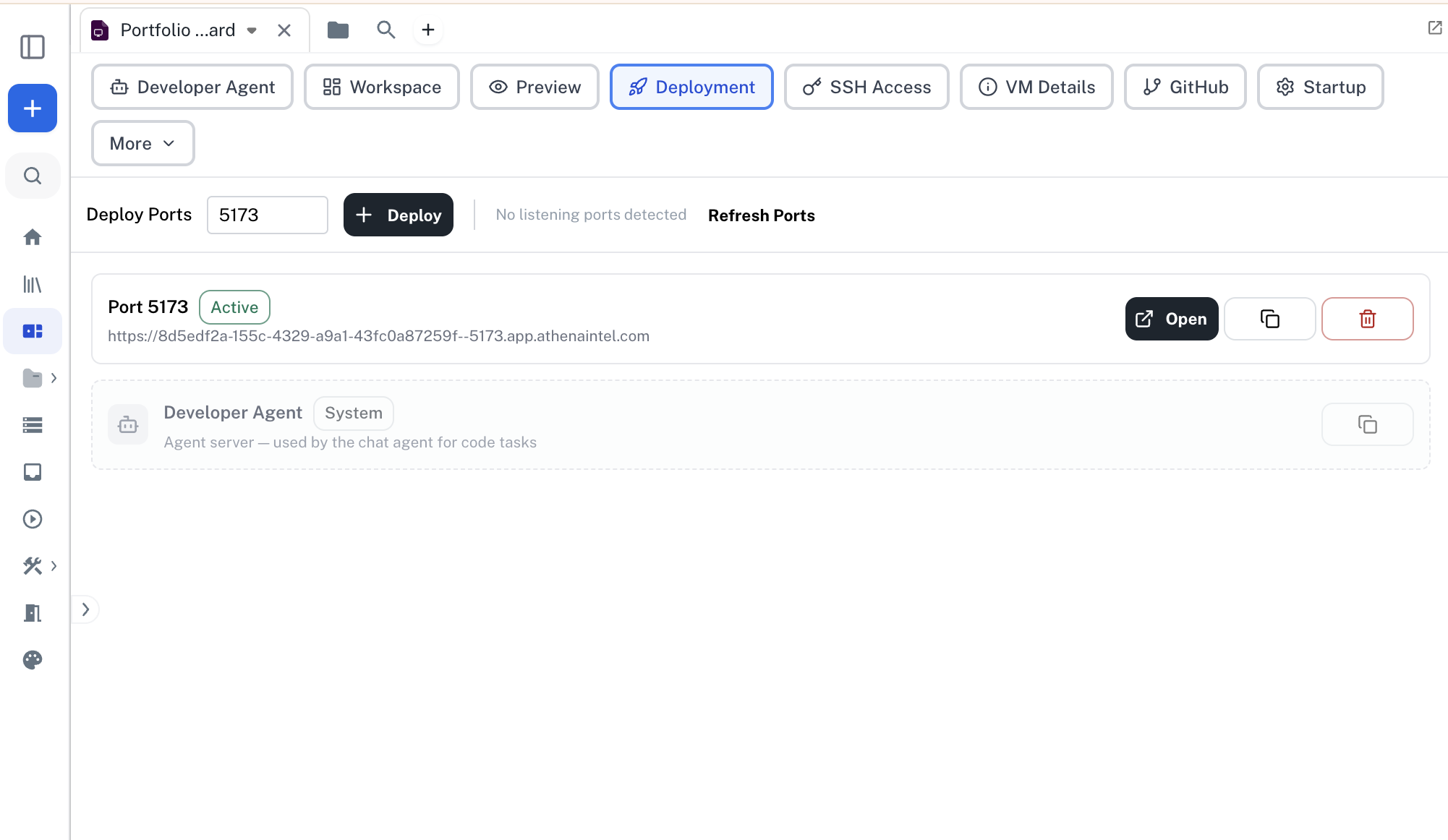
When you open a computer asset, the first thing you see is the Developer Agent — a conversational interface where you describe the work that needs to happen. From there, the agent explores your codebase, writes code, runs tests, and debugs issues autonomously. Alongside it, a full Workspace provides a file explorer and terminal for direct access when you need it. A live Preview renders what is being built in real time. And when the work is ready, a single Deployment step publishes it to a shareable URL. The entire development lifecycle — from conversation to production — lives inside one environment.
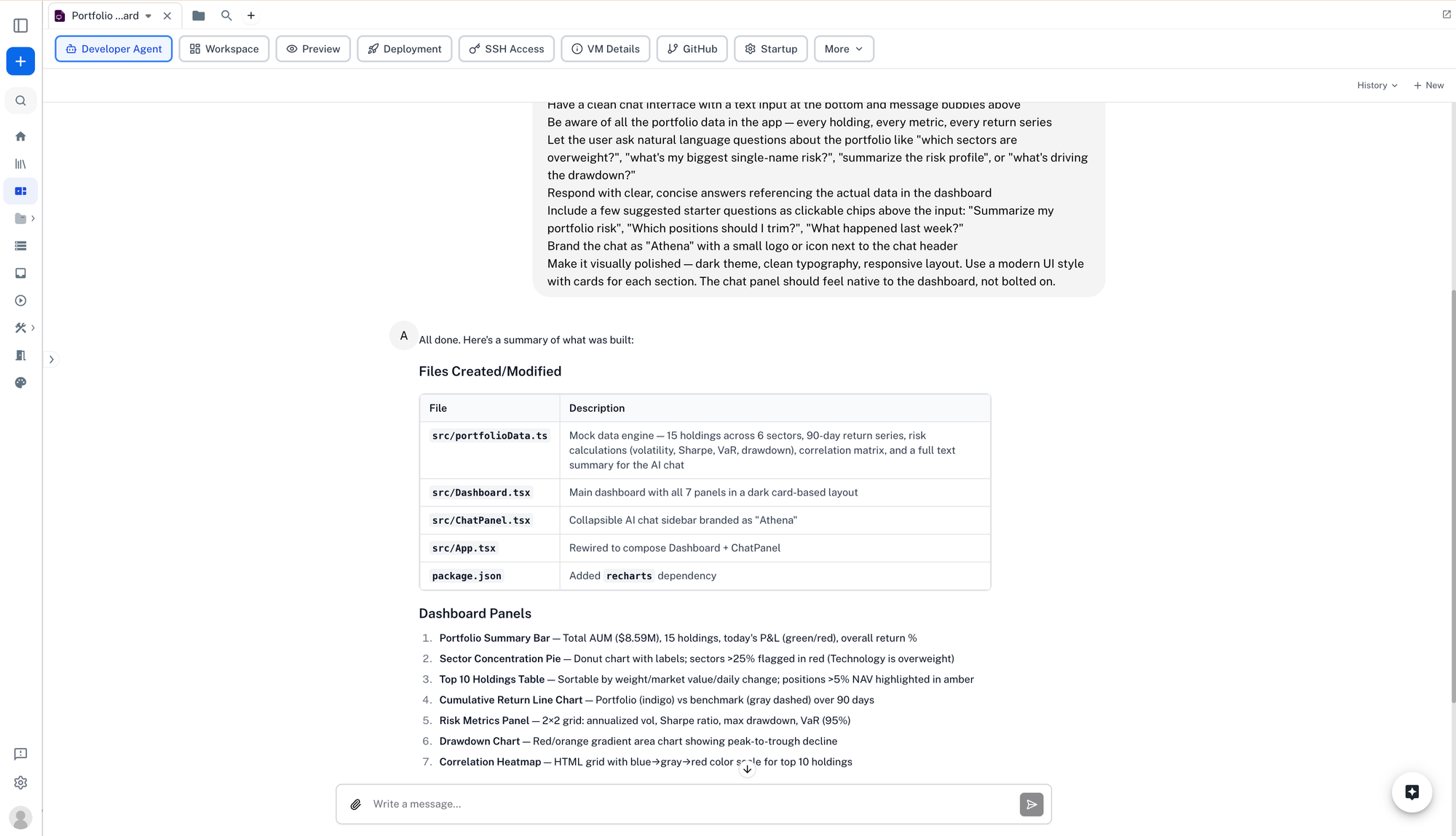
It plans and builds, not just suggests.
The work begins with a conversation. You describe what you need — the application, the functionality, the intended behavior. From there, the system conducts a full planning session: architecture decisions, resource allocation, component design. It produces diagrams, source documents, and a structured plan before writing a single line of code. Then it builds. Not isolated snippets or code suggestions — complete, multi-page applications with the complexity that real production environments demand.
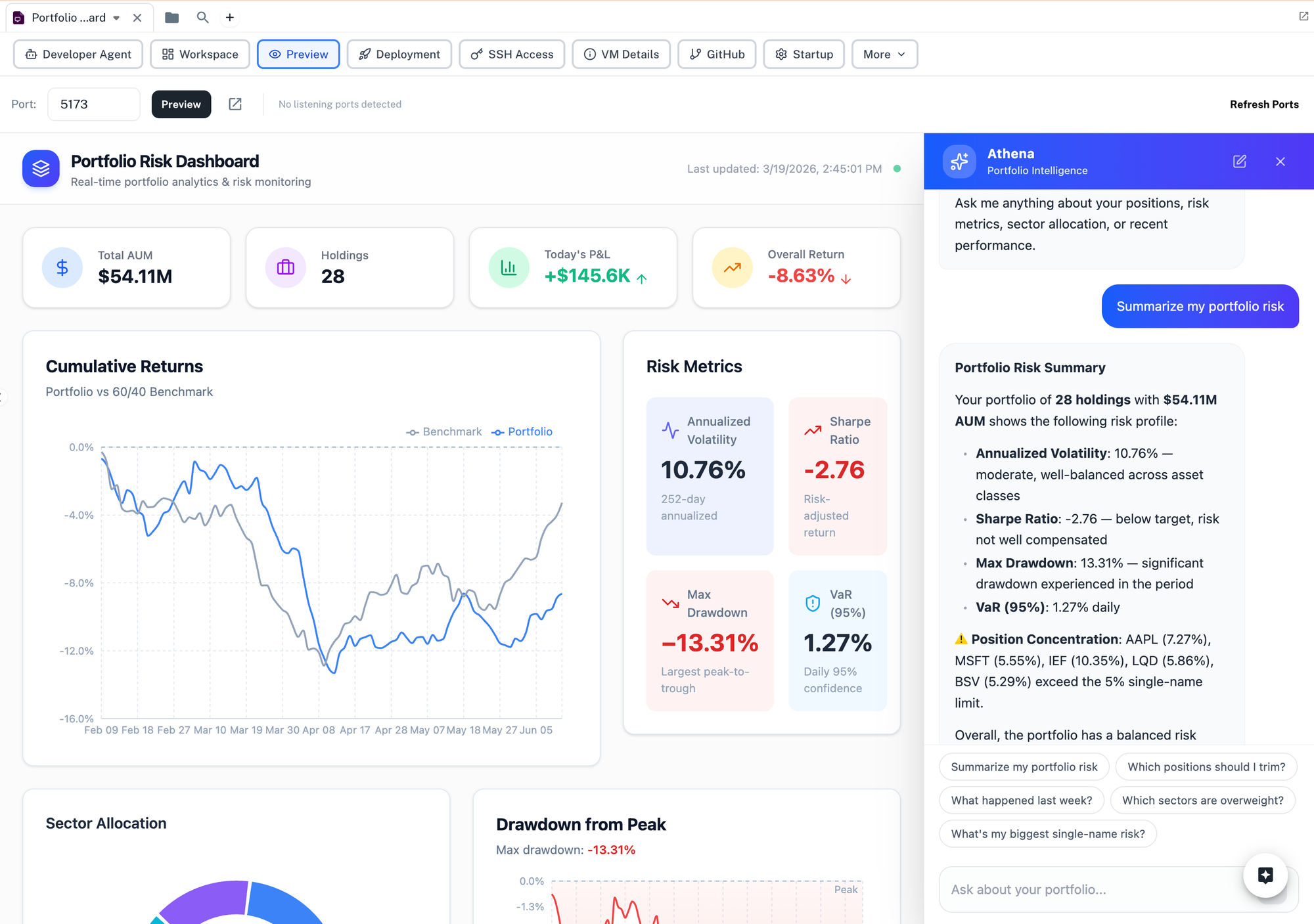
It follows your standards, not generic defaults.
Every organization has its own conventions. Style guidelines. Testing frameworks. Branding requirements. Coding standards that have been refined over years. An AI developer operating as a service does not override those with its own defaults. It reads your internal documentation, adheres to your conventions, and produces output that is consistent with what your team would have built — because it is working from the same standards your team works from.
It ships to production.
The work does not stop at a pull request. Code gets pushed to your repositories. Your CI/CD pipelines run. Your test suites execute. The deployed output gets validated in a browser. The full development lifecycle — from planning through deployment — happens within a single workflow. What previously required coordination across multiple team members and multiple handoffs gets executed end to end.
It works in isolation.
Every task runs inside a secure, ephemeral environment. Fully separated from your other systems, your other data, your other workloads. When the task is complete, the environment is disposable. There is no persistent footprint, no cross-contamination between workloads. Isolation is not a feature that gets configured after deployment — it is the default architecture.
It learns from your ecosystem.
The system is not operating in a vacuum. It can reference your documentation, search external resources relevant to the task, and follow skill-specific guidelines that you define. When your team relies on particular frameworks, libraries, or internal standards, the AI developer has access to those same resources. The context it operates in mirrors the context your human developers operate in.
Built for the Enterprise
There is a meaningful difference between software that was designed for enterprise use and software that was adapted for it after the fact.
Enterprise deployment means your data stays within your infrastructure. It means the platform can run on-premises, inside your own environment, under your own governance. It means your security and compliance teams do not have to negotiate exceptions — the architecture already accounts for their requirements.
It also means the software becomes yours in a real sense. Full branding. Full customization. The ability to build internal applications on top of the platform that look and feel like they were developed in-house — because, in every way that matters to your end users, they were. Your team interacts with a system that carries your identity and operates within your workflows, while the underlying platform handles the complexity.
And the AI does not work in a silo. It supports collaboration protocols that allow it to communicate and coordinate with your existing teams and systems. It operates as a participant in your workflows, not as a separate environment your people have to context-switch into.
SaaS gave every enterprise access to world-class tools. That was the right model for the era it emerged in, and it continues to serve a critical function.
But the next phase of enterprise software is not about building better tools. It is about building software that delivers work — software that you delegate to, not software that you operate. The shift from tool to service is not a replacement of what came before. It is the natural next step, driven by the reality that most organizations have more work than they have people to do it.
The question for enterprise leaders is starting to change. It is no longer just "what software does your team use?" It is "what work does your software do?"